Leather is a durable and flexible material created by the tanning of animal rawhide and skin, often cattle hide. It can be produced through manufacturing processes ranging from cottage industry to heavy industry.
 |
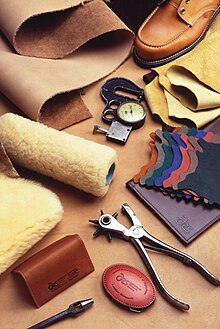
| Modern leather-working tools |
Several tanning processes transform hides and skins into leather:
- Vegetable-tanned leather is tanned using tannins and other ingredients found in different vegetable matter, such as tree barkprepared in bark mills, wood, leaves, fruits and roots and other similar sources. It is supple and brown in color, with the exact shade depending on the mix of chemicals and the color of the skin. It is the only form of leather suitable for use in leather carving or stamping. Vegetable-tanned leather is not stable in water; it tends to discolor, so if left to soak and then dry it will shrink and become less supple, and harder. In hot water, it will shrink drastically and partly gelatinize, becoming rigid and eventually brittle.Boiled leather is an example of this, where the leather has been hardened by being immersed in hot water, or in boiled wax or similar substances. Historically, it was occasionally used as armor after hardening, and it has also been used for book binding. Vegetable tanned leathers present unique, recognisable and natural characteristics while respecting the environment, thanks to the heritage of expert craftsman and the use of old traditional recipes, new technologies and natural tannins.[1]
- Chrome-tanned leather, invented in 1858, is tanned using chromium sulfate and other salts of chromium. It is more supple and pliable than vegetable-tanned leather and does not discolor or lose shape as drastically in water as vegetable-tanned. It is also known as wet-blue for its color derived from the chromium. More esoteric colors are possible using chrome tanning.
- Aldehyde-tanned leather is tanned using glutaraldehyde or oxazolidine compounds. This is the leather that most tanners refer to as wet-white leather due to its pale cream or white color. It is the main type of "chrome-free" leather, often seen in automobiles and shoes for infants.
- Formaldehyde tanning (being phased out due to its danger to workers and the sensitivity of many people to formaldehyde) is another method of aldehyde tanning. Brain-tanned leathers fall into this category and are exceptionally water absorbent.
- Brain tanned leathers are made by a labor-intensive process which uses emulsified oils, often those of animal brains. They are known for their exceptional softness and their ability to be washed.
- Chamois leather also falls into the category of aldehyde tanning and, like brain tanning, produces a highly water-absorbent leather. Chamois leather is made by using oils (traditionally cod oil) that oxidize easily to produce the aldehydes that tan the leather to make the fabric the color it is.
- Rose tanned leather is a variation of vegetable oil tanning and brain tanning, where pure rose otto replaces the vegetable oil and emulsified oils. It has been called the most valuable leather on earth, but this is mostly due to the high cost of rose otto and its labor-intensive tanning process.
- Synthetic-tanned leather is tanned using aromatic polymers such as the Novolac or Neradol types (syntans, contraction forsynthetic tannins). This leather is white in color and was invented when vegetable tannins were in short supply during the Second World War. Melamine and other amino-functional resins fall into this category as well, and they provide the filling that modern leathers often require. Urea-formaldehyde resins were also used in this tanning method until dissatisfaction about the formation of free formaldehyde was realized.
- Alum-tawed leather is transformed using aluminium salts mixed with a variety of binders and protein sources, such as flour and egg yolk. Alum-tawed leather is technically not tanned, as tannic acid is not used, and the resulting material will revert to rawhide if soaked in water long enough to remove the alum salts. Very light shades of leather are possible using this process, but the resulting material is not as supple as vegetable-tanned leather.[2]
- Rawhide is made by scraping the skin thin, soaking it in lime, and then stretching it while it dries. Like alum-tawing, rawhide is not technically "leather"[citation needed], but is usually lumped in with the other forms. Rawhide is stiffer and more brittle than other forms of leather; it's primarily found in uses such as drum heads and parchment where it does not need to flex significantly; it is also cut up into cords for use in lacing or stitching and for making many varieties of dog chews.
Leather—usually vegetable-tanned—can be oiled to improve its water resistance. This supplements the natural oils remaining in the leather itself, which can be washed out through repeated exposure to water. Frequent oiling of leather, with
mink oil,
neatsfoot oil, or a similar material keeps it supple and improves its lifespan dramatically.
Leather with the hair still attached is called hair-on.
In general, leather is sold in four forms:
- Full-grain leather refers to hides that have not been sanded, buffed, or snuffed (as opposed to top-grain or corrected leather) to remove imperfections (or natural marks) on the surface of the hide. The grain remains allowing the fiber strength and durability. The grain also has breathability, resulting in less moisture from prolonged contact. Rather than wearing out, it will develop a patina over time. High quality leather furniture and footwear are often made from full-grain leather. Full-grain leathers are typically available in two finish types: aniline and semi-aniline.
- Top-grain leather (the most common type used in high-end leather products) is the second-highest quality. It has had the "split" layer separated away, making it thinner and more pliable than full-grain. Its surface has been sanded and a finish coat added to the surface which results in a colder, plastic feel with less breathability, and it will not develop a natural patina. It is typically less expensive and has greater resistance to stains than full-grain leather, so long as the finish remains unbroken.
- Corrected-grain leather is any leather that has had an artificial grain applied to its surface. The hides used to create corrected leather do not meet the standards for use in creating vegetable-tanned or aniline leather. The imperfections are corrected or sanded off, and an artificial grain impressed into the surface and dressed with stain or dyes. Most corrected-grain leather is used to make pigmented leather as the solid pigment helps hide the corrections or imperfections. Corrected grain leathers can mainly be bought as two finish types: semi-aniline and pigmented.
- Split leather is leather created from the fibrous part of the hide left once the top-grain of the rawhide has been separated from the hide. During the splitting operation, the top-grain and drop split are separated. The drop split can be further split (thickness allowing) into a middle split and a flesh split. In very thick hides, the middle split can be separated into multiple layers until the thickness prevents further splitting. Split leather then has an artificial layer applied to the surface of the split and is embossed with a leather grain (bycast leather). Splits are also used to create suede. The strongest suedes are usually made from grain splits (that have the grain completely removed) or from the flesh split that has been shaved to the correct thickness. Suede is "fuzzy" on both sides. Manufacturers use a variety of techniques to make suede from full-grain. A reversed suede is a grained leather that has been designed into the leather article with the grain facing away from the visible surface. It is not considered to be a true form of suede.[3]
Less-common leathers include:
- Buckskin or brained leather is a tanning process that uses animal brains or other fatty materials to alter the leather. The resulting supple, suede-like hide is usually smoked heavily to prevent it from rotting.
- Fish Leather : leather popular for its motifs and its pigmentation. Mainly used for making shoes and bags, the fish skin is tanned like other animal skins.[4] The species used include salmon, perch, sturgeon, etc.
- Salmon : farmed in Iceland and Norway, salmon skin has fine scales. Its strength and elegant look make it the most popular fish leather.
- Perch : coming from Nile, its skin is recognizable with its large, round and soft scales.
- Wolffish : its skin is smooth because without scales. We recognize it thanks to its dark spots, and the 'stripes' which are due to the friction of marine rocks.
- Cod : its skin has finer scales than salmon, but its texture is more varied, sometimes smooth and sometimes rough.
- Sturgeon : fish well known for its eggs (caviar), which make it rare. Its leather is thus quite expensive.
- Eel : fish without scales, its skin has a shiny appearance.
- Tilapia : its leather is less resistant than salmon and perch but is still exotic. It comes mainly from Africa (Nile).
- Shagreen is also known as stingray skin/leather. Applications used in furniture production date as far back as the art decoperiod. The word "shagreen" originates from France. It's known as the most difficult leather to work due to dished scales of the animal, and it is one of the most expensive leathers.
- Shark : its skin is covered of small, close-set tubercles, making it very tough. The handbags made of shark skin used to be in vogue but this keen interest has since fallen as the costs of production and of the leather itself are very high. Moreover, this skin is more difficult to work.
- Vachetta leather is used in the trimmings of luggage and handbags. The leather is left untreated and is therefore susceptible to water and stains. Sunlight will cause the natural leather to darken in shade, called a patina.
- Slink is leather made from the skin of unborn calves. It is particularly soft and is valued for use in making gloves.
- Deerskin is a tough leather, possibly due to the animal's adaptations to its thorny and thicket-filled habitats.[citation needed] Deerskin has been used by many societies, including indigenous Americans. Most modern deerskin is no longer procured from the wild, with deer farms breeding the animals specifically for the purpose of their skins. Large quantities are still tanned from wild deer hides in historic tanning towns such as Gloversville and Johnstown in upstate New York. Deerskin is used in jackets and overcoats, martial arts equipment such as kendo and bogu, as well as personal accessories such as handbags and wallets.
- Nubuck is top-grain cattle hide leather that has been sanded or buffed on the grain side, or outside, to give a slight nap of short protein fibers, producing a velvet-like surface.
There are two other types of leather commonly used in specialty products, such as briefcases, wallets, and luggage:
- Belting leather is a full-grain leather that was originally used in driving pulley belts and other machinery. It is found on the surface of briefcases, portfolios, and wallets, and can be identified by its thick, firm feel and smooth finish. Belting leather is generally a heavy-weight of full-grain, vegetable-tanned leather.
- Napa leather is chrome-tanned and is soft and supple. It is commonly found in wallets, toiletry kits, and other personal leather goods.
The following are not "true" leathers, but are synthetic materials that contain some leather fiber. Depending on jurisdiction, they may still be labeled as "Genuine Leather", even though the consumer generally can only see the plastic outer layer of the material and can't actually see any of the leather content:
- "Reconstituted leather", is composed of up to 90% leather fibers (often scrap from leather tanneries or leather workshops) bonded together with a plastic or latex binders to create a look and feel similar to that of leather at a fraction of the cost. The resulting material is not as durable as real leather and is recommended for use only if the product will be used infrequently.
- "Bonded leather" used for upholstery is a plastic (generally vinyl or polyurethane) material that contains about 17% leather fiber in its backing material. The plastic is stamped to give it a leather-like texture. Bonded leather upholstery is as durable as other plastic materials and its manufacturing process is more environmentally-friendly than leather production.[citation needed]
- Bycast leather is a split leather with a layer of polyurethane applied to the surface and then embossed. Bycast was originally made for the shoe industry and recently was adopted by the furniture industry. The original formula created by Bayer was strong but expensive. The result is a plastic material that is slightly stiffer but cheaper than top-grain leather but has a much more consistent texture. Because its surface is completely covered in plastic, is easier to clean and maintain.
From other animals[edit]
Today most leather is made of
cattle skin but many exceptions exist. Lamb and deerskin are used for soft leather in more expensive apparel. Deer and elkskin are widely used in work gloves and indoor shoes. Pigskin is used in apparel and on seats of
saddles. Buffalo, goats, alligators, dogs,
snakes, ostriches, kangaroos, oxen, and yaks may also be used for leather.
Kangaroo skin is used to make items which need to be strong but flexible—it is the material most commonly used in
bullwhips. Kangaroo leather is favored by some
motorcyclists for use in
motorcycle leathers specifically because of its light weight and abrasion resistance.
[5]Kangaroo leather
[6] is also used for falconry jesses and soccer footwear.
[7]
At different times in history, leather made from more exotic skins has been considered desirable. For this reason certain species of
snakes and
crocodiles have been hunted.
[citation needed]
Although originally raised for their feathers in the 19th century,
ostriches are now more popular for both meat and leather.
[8] There are different processes to produce different finishes for many applications, i.e., upholstery, footwear, automotive products, accessories, and clothing.
Ostrich leather is currently used by many major fashion houses such as
Hermès,
Prada,
Gucci, and
Louis Vuitton. Ostrich leather has a characteristic "goose bump" look because of the large follicles from which the feathers grew.
In
Thailand sting ray leather is used in wallets and belts. Sting ray leather is tough and durable. The leather is often dyed black and covered with tiny round bumps in the natural pattern of the back ridge of an animal. These bumps are then usually dyed white to highlight the decoration. Sting ray leather is also used as grips on Chinese swords, Scottish basket hilted swords and Japanese
katanas.
Production processes[edit]
The leather manufacturing process is divided into three fundamental sub-processes:preparatory stages, tanning, and crusting. All true leathers will undergo these sub-processes. A further sub-process, surface coating, can be added into the leather process sequence, but not all leathers receive surface treatment. Since many types of leather exist, it is difficult to create a list of operations that all leathers must undergo.
The
preparatory stages are when the hide/skin is prepared for tanning. Preparatory stages may include: preservation, soaking,
liming,
unhairing, fleshing,
splitting, reliming,
deliming,
bating,
degreasing, frizing,
bleaching,
pickling, and depickling.
Tanning is the process which matches the
protein of the raw hide or skin into a stable material which will not putrefy and is suitable for a wide variety of end applications. The principal difference between raw hides and tanned hides is that raw hides dry out to form a hard inflexible material that when re-wetted (or wetted back) putrefy, while tanned material dries out to a flexible form that does not become putrid when wetted back. Many different tanning methods and materials can be used; the choice is ultimately dependent on the end application of the leather. The most commonly used tanning material is
chromium, which leaves the leather, once tanned, a pale blue color (due to the chromium); this product is commonly called "wet blue". The hides once they have finished pickling will typically be between
pH 2.8 and 3.2.
[citation needed] At this point, the hides would be loaded in a drum and immersed in a float containing the tanning liquor. The hides are allowed to soak (while the
drum slowly rotates about its
axle) and the tanning liquor slowly penetrates through the full substance of the hide. Regular checks will be made to see the penetration by cutting the cross-section of a hide and observing the degree of penetration. Once an even degree of penetration exists, the pH of the float is slowly raised in a process called basification. This basification process fixes the tanning material to the leather and the more tanning material fixed, the higher the hydrothermal stability and increased
shrinkage temperature resistance of the leather. The pH of the leather when chrome tanned would typically finish somewhere between 3.8 and 4.2.
[citation needed]
Crusting is the process by which the hide/skin is thinned, retanned, and lubricated. Often a coloring operation is included in the crusting subprocess. The chemicals added during crusting must be fixed in place. The culmination of the crusting subprocess is the drying and softening operations. Crusting may include the following operations:
wetting back, sammying, splitting, shaving, rechroming,
neutralization, retanning,
dyeing, fatliquoring, filling, stuffing, stripping,
whitening, fixating, setting, drying, conditioning, milling, staking, and buffing.
For some leathers, a surface coating is applied. Tanners refer to this as finishing. Finishing operations may include: oiling, brushing, padding, impregnation, buffing, spraying, roller coating,
curtain coating,
polishing,
plating,
embossing,
ironing, ironing/combing (for hair-on),
glazing, and
tumbling.
Environmental impact[edit]
Leather is a product with some environmental impact, most notably due to:
- the use of chemicals in the tanning process (e.g. chromium, formic acid, mercury and solvents, ...)
- air pollution due to the transformation process (hydrogen sulfide during dehairing and ammonia during deliming, solvent vapors).
- Leather biodegrades slowly; it takes 25–40 years to decompose. However, vinyl and petro-chemical derived materials will take 500 or more years to break down and return to the earth.
One ton of hide or skin generally leads to the production of 20 to 80 m
3 of wastewater including chromium levels of 100–400 mg/L, sulfide levels of 200–800 mg/L and high levels of fat and other solid wastes, as well as notable pathogen contamination. Pesticides are also often added for hide conservation during transport. With solid wastes representing up to 70% of the wet weight of the original hides, the tanning process comes at a considerable strain on water treatment installations.
[9]
Tanning is especially polluting in countries where environmental regulations are lax, such as in India, the world's third-largest producer and exporter of leather. To give an example of an efficient pollution prevention system, chromium loads per produced tonne are generally abated from 8 kg to 1.5 kg.
VOC emissions are typically reduced from 30 kg/t to 2 kg/t in a properly managed facility. A review of the total pollution load decrease achievable according to the
United Nations Industrial Development Organization[10] posts precise data on the abatement achievable through industrially proven low-waste advanced methods, while noting that "even though the chrome pollution load can be decreased by 94% on introducing advanced technologies, the minimum residual load 0.15 kg/t raw hide can still cause difficulties when using landfills and composting sludge from wastewater treatment on account of the regulations currently in force in some countries."
In
Kanpur, the self-proclaimed "Leather City of World" with 10,000 tanneries as of 2011 and a city of 3 million people on the banks of the river
Ganges, pollution levels were so high that despite an industry crisis, the pollution control board has decided to seal 49 high-polluting tanneries out of 404 in July 2009.
[11] In 2003 for instance, the main tanneries' effluent disposal unit was dumping 22 tonnes of chromium-laden solid waste per day in the open.
[12] Scientists at the Central Leather Research Institute in India have developed biological methods for pretanning as well as
better chromium management.
In the Hazaribagh neighborhood of Dhaka in
Bangladesh, chemicals from tanneries end up in Dhaka's main river. Besides the environmental damage, the health of both local factory workers and the end consumer is also negatively affected. Besides local sales of products made with leather from the Hazaribagh neighborhood of Dhaka, the leather is also bought by huge Western companies and sold in the developed world.
[13][14]
The higher cost associated to the treatment of effluents that to untreated effluent discharging leads to illegal dumping to save on costs. For instance, in
Croatia in 2001, proper pollution abatement cost 70-100 USD/t of raw hides processed against 43 USD/t for irresponsible behavior.
[15]
No general study seems to exist but the current news is rife with documented examples.
[clarification needed] In November 2009 for instance, it was discovered that one of Uganda's main leather producing companies directly dumped its waste water in a wetland adjacent to
Lake Victoria.
[16]
Role of enzymes[edit]
Enzymes like
proteases,
lipases, and
amylases have an important role in the soaking, dehairing, degreasing, and bating operations of leather manufacturing.
Proteases are the most commonly used enzymes in leather production. The enzyme used should not damage or dissolve
collagen or
keratin, but should be able to hydrolyze
casein,
elastin,
albumin, and
globulin-like proteins, as well as non-structured proteins which are not essential for leather making. This process is called bating.
[17]
Lipases are used in the degreasing operation to hydrolyze fat particles embedded in the skin.
[18]
Amylases are used to soften skin, to bring out the grain, and to impart strength and flexibility to the skin. These enzymes are rarely used.
Preservation and conditioning[edit]
The natural fibers of leather will break down with the passage of time. Acidic leathers are particularly vulnerable to
red rot, which causes powdering of the surface and a change in consistency. Damage from red rot is aggravated by high temperatures and relative humidities and is irreversible.
Exposure to long periods of low relative humidities (below 40%) can cause leather to become desiccated, irreversibly changing the fibrous structure of the leather. Chemical damage can also occur from exposure to environmental factors, including ultraviolet light, ozone, acid from sulfurous and nitrous pollutants in the air, or through a chemical action following any treatment with tallow or oil compounds. Both oxidation and chemical damage occur faster at higher temperatures.
Various treatments are available such as
conditioners, but these are not recommended by
conservators since they impregnate the structure of the leather artifact with active chemicals, are sticky, and attract stains.
[citation needed] Saddle soap is used for cleaning, conditioning and softening leather. Leather shoes are widely conditioned with
shoe polish.
Book binding[edit]
Leather used in book binding has many of the same preservation needs: protection from high temperatures, high relative humidity, low relative humidity, fluctuations in relative humidity, light exposure, dust buildup, pollution, mold, and bug infestation.
[19][20]
For books with red rot, acid-free phase boxes and/or polyester dust jackets (Dupont Mylar Type D or ICI Mellinex 516) are recommended to protect the leather from further handling damage and as well as to prevent the residues from getting on hands, clothes, the text block, and nearby books.
[21]
The debate on the use of dressings for preservation of book bindings has spanned several decades as research and experimental evidence have slowly accumulated. The main argument is that, done incorrectly, there are multiple disadvantages and that, done correctly, there is little to no preservation advantage. Pamphlets and guidelines give numerous downsides to dressings use, including: the dressing becoming increasingly acidic and will discolor and stain the leather, oxidize (penetration and expansion of oils including displacement and weakening of fibers) and stiffen, leave a sticky surface, collect dust, wick into adjacent materials, form unstable surface spews, encourage biological deterioration and mold growth, block surface porosity, impede further treatment, wet and swell the leather, affect surface finishes, and desiccate or dry out the leather.
[22] Meanwhile, scientific experiments have shown no substantial benefits.
[23] The main authorities on the subject therefore discourage it, with a caveat for special cases done under the direction of a conservator.
[19][21][22]
Leathercrafting[edit]
Cordwain and Cuir de Cordoue[edit]
Cordwain, once a synonym of
cordovan (through
Old French cordewan) meaning "from
Córdoba" describes a certain kind of fine leather, originally from Córdoba.
Cordwainer is still used to describe someone in the profession of
shoemaking.
The related term
Cuir de Cordoue refers to painted and
gilded (and sometimes
embossed) leather hangings manufactured in panels and assembled for covering walls as an alternative to
tapestry.
In modern culture[edit]

A motorcycle-style leather jacket.
Due to its excellent resistance to abrasion and wind, leather found a use in rugged occupations. The enduring image of a
cowboy in leather
chaps gave way to the leather-jacketed and leather-helmeted
aviator. When
motorcycles were invented, some riders took to wearing heavy leather
jackets to protect from
road rash and wind blast; some also wear chaps or full leather pants to protect the lower body. Top-quality motorcycle leather is superior to any practical man-made fabric for abrasion protection and is still used in racing. Many sports still use leather to help in playing the game or protecting players; its flexibility allows it to be formed and flexed.
Leather fetishism is the name popularly used to describe a
fetishistic attraction to people wearing leather, or in certain cases, to the garments themselves.
Many
rock groups (particularly
heavy metal and
punk groups in the 1980s) are well known for wearing leather clothing. Leather clothing, particularly jackets, are common in the heavy metal and Punk subculture.
Extreme metal bands (especially
black metal bands) and
Goth rock groups have extensive leather clothing, i.e. leather pants, accessories, etc.
Many cars and trucks come with optional or standard "leather" seating. This can range from cheap
vinyl imitation leather, found on some low cost vehicles, to real
Napa leather, found on certain models of luxury car brands like
Mercedes-Benz,
BMW, and
Audi.
Leather is used exclusively by publishers like The
Easton Press to bind books, for both practical and aesthetic purposes.
Religious sensitivities[edit]
In religiously diverse countries, leather vendors are typically careful to clarify the kinds of leather used in their products. For example, leather shoes will bear a label identifying the animal from which the leather was taken. In this way, a
Muslim would not accidentally purchase
pigskin leather,
[citation needed] and a
Hindu could avoid
cow leather. Many Hindus who are vegetarians will not use any kind of leather.
Such
taboos increase the demand for religiously neutral leathers like
ostrich and
deer.
Jainism prohibits the use of leather since it is obtained by killing animals.
Alternatives[edit]
Some
vegans and
animal rights activists
boycott the use of all items made from leather, believing the practice of wearing animal hides to be unnecessary and cruel. Animal rights groups such as
PETA have called for boycotts and encourage the use of alternative materials such as
synthetic leathers.
Many pseudo-leather materials have been developed, allowing those who wish to wear leather-like garments to do so without actually wearing leather. One example of this is vegan
microfiber, which claims to be stronger than leather when manufactured with strength in mind. Vinyl materials,
pleather,
Naugahyde, Durabuck, NuSuede, Hydrolite, and other alternatives exist, providing some features similar to leather.
[citation needed]