Pages

Labels

kelasjoomla.com. Powered by Blogger.
Showing posts with label Intro. Show all posts

Saturday, 15 June 2013

Shoemaking

Shoemaking is the process of making footwear. Originally, shoes were made one at a time by hand. Traditional handicraft shoemaking has now been largely superseded in volume of shoes produced by industrial mass production of footwear, but not necessarily in quality, attention to detail, or craftsmanship.
Shoemakers or cordwainers (cobblers being, historically, those who repair shoes) may produce a range of footwear items, including shoes, boots, sandals, clogs and moccasins. Such items are generally made of leather, wood, rubber, plastic, jute or other plant material, and often consist of multiple parts for better durability of the sole, stitched to a leather upper.

Woodcut of shoemakers from 1568

Sizes

Shoe size is an alphanumerical indication of the fitting size of a shoe for a person. Often it just consists of a number indicating the length because many shoemakers only provide a standard width for economic reasons. There are several different shoe-size systems that are used worldwide. These systems differ in what they measure, what unit of measurement they use, and where the size 0 (or 1) is positioned. Only a few systems also take the width of the feet into account. Some regions use different shoe-size systems for different types of shoes (e.g., men's, women's, children's, sport, or safety shoes).
Units for shoe sizes vary widely around the world. European sizes are measured in Paris Points, which are worth two-thirds of a centimeter. The UK and American units are approximately one-quarter of an inch, starting at 8¼ inches. Men's and women's shoe sizes often have different scales. Shoes size is often measured using a Brannock Device, which can determine both the width and length of the foot.
The Brannock Device is a measuring instrument invented by Charles F. Brannock for measuring a person's shoe size. The son of a shoe industry entrepreneur, Brannock attended Syracuse University, New York, U.S.A. where he became a member of the Delta Kappa Epsilon fraternity. Brannock spent two years developing a simple means of measuring the length, width and arc length of the human foot. He eventually improved on the wooden RITZ Stick, the industry standard of the day, and patented his first prototype in 1926. The device has both left and right heel cups and is rotated through 180 degrees to measure the second foot. Brannock later formed the Brannock Device Company to manufacture and sell the product, and headed the company until 1992 when he died at age 89. Today, the Brannock Device is an international standard of the footwear industry, and theSmithsonian Institution houses samples of some of the first Brannock Devices.
The Brannock Device Company was headquartered in Syracuse, New York, until shortly after Charles Brannock's death. Salvatore Leonardi purchased the company from the Brannock Estate in 1993, and moved manufacturing to a small factory in Liverpool, New York. The company continues to manufacture several models of the device for determining the shoe sizes of men, women, and children; they also produce specialized models for fitting other types of footwear.

Maintenance

  • Breaking-in: some shoes are made of hard but deformable material. After a person wears them multiple times, the material reforms to fit the wearer's feet. The person is said to have "broken in" the shoes.
  • Polishing: for protection, water resistance (to some extent) and appearance, especially for leather shoes and boots.
  • Heel replacement: heels periodically wear out. Not all shoes are designed to enable this.
  • Sanitization: the inside of shoes can be sanitized with germicidal shoe trees or other cleansing methods to prevent the growth of microorganisms such as odor-causing bacteria or fungi.
  • Sole replacement: soles can also wear out. Not all shoes can have their soles replaced.
  • Shoelace replacement: shoelaces can sometimes be damaged or destroyed necessitating the replacement of the laces.
  • When unfit for use, shoes can be treated as trash or municipal solid waste and disposed of. The exception can be with mostathletic sneakers which can be recycled and turned into other raw materials. See Nike Grind as an example.
A person who makes or repairs shoes in a shop is called a cobbler.

Footwear

Footwear refers to garments worn on the feet, for fashion, protection against the environment, and adornment. Being barefoot is commonly associated with poverty, but some cultures chose not to wear footwear, at least in some situations.
Socks and other hosiery are typically worn between the feet and other footwear, less often with sandals or flip flops (thongs). Footwear is sometimes associated with fetishism, particularly in some fashions in shoes, including boots.
Durable shoes are a relatively recent invention, though many ancient civilizations wore ornamental footwear. Many ancient civilizations saw no need for footwear. The Romans saw clothing and footwear as signs of power and status in society, and most Romans wore footwear, while slaves and peasants remained barefoot.[1] The Middle Ages saw the rise of high-heeled shoes, also associated with power, and the desire to look larger than life, and artwork from that period often depicts bare feet as a symbol of poverty. Bare feet are also seen as a sign of humility and respect, and adherents of many religions worship or mourn while barefoot, or remove their shoes as a sign of respect towards someone of higher standing.
In some cultures, people remove their shoes before entering a home. Some religious communities require people to remove shoes before they enter holy buildings, such as temples.
Practitioners of the craft of shoemaking are called shoemakers, cobblers, or cordwainers.

History[edit]

During the Middle Ages, men and women wore pattens, commonly seen as the predecessor of the modern high-heeled shoe,[2] while the poor and lower classes in Europe, as well as slaves in the New World, were barefoot.[3] In the 15th century, chopines were created in Turkey, and were usually 7-8 inches (17.7-20.3 cm) high. These shoes became popular in Venice and throughout Europe, as a status symbol revealing wealth and social standing.
During the 16th century, royalty such as Catherine de Medici and Mary I of England began wearing high-heeled shoes to make them look taller or larger than life. By 1580, men also wore them, and a person with authority or wealth might be described as, well-heeled.[2]In modern society, high-heeled shoes are a part of women's fashion, perhaps more as a sexual prop[citation needed].

Materials[edit]

Components[edit]

Types[edit]


Shoes made from crocodile skin, in a conservation exhibit at Bristol Zoo, England

An artist's impression of Ötzi's right shoe. Ötzi is a male mummy found in the Austrian Alps in September 1991 in remarkably well-preserved condition.

Footwear industry[edit]

In Europe, the footwear industry has declined in the last years. While in 2005, there were about 27.000 firms, in 2008 there were only 24.000. As well as the number of firms, the direct employment has decreased. The only factors that remained almost steady was the value added at factor cost and production value.[4]
In the U.S., the annual footwear industry revenue was $48 billion in 2012. There are about 29.000 shoe stores in the U.S. and the shoe industry employs about 189.000 people. [5] Due to rising imports, these numbers are also declining. The only way of staying afloat in the shoe market is to establish a presence in niche markets.[6]

Safety of footwear products[edit]

To ensure high quality and safety of footwear, manufacturers have to make sure all products comply to existing and relevant standards. By producing footwear in accordance with national and international regulations, potential risks can be minimized and the interest of both textile manufacturers and consumers can be protected. The following standards/regulations apply to footwear products:

Parts

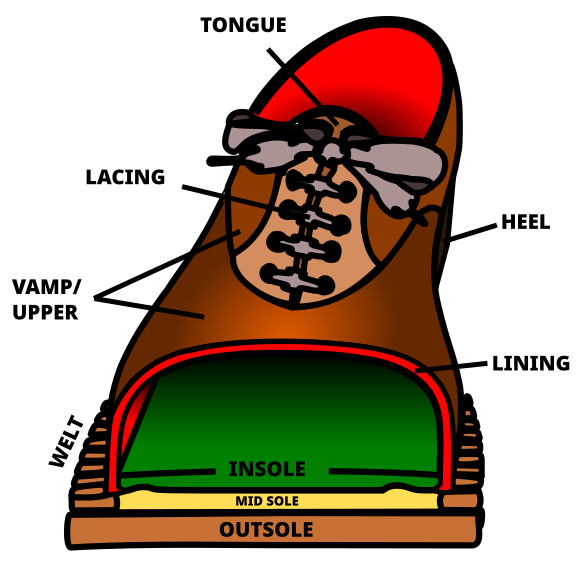
The basic anatomy of a shoe is recognizable, regardless of the specific style of footwear.
All shoes have a "sole", which is the bottom of a shoe, in contact with the ground. Soles can be made from a variety of materials, although most modern shoes have soles made fromnatural rubber, polyurethane, or polyvinyl chloride (PVC) compounds.[31] Soles can be simple — a single material in a single layer — or they can be complex, with multiple structures or layers and materials. When various layers are used, soles may consist of an "insole", "midsole", and an "outsole".[32]
The insole is the interior bottom of a shoe, which sits directly beneath the foot under the footbed (also known as sock liner). The purpose of insole is to attach to the lasting margin of the upper, which is wrapped around the last during the closing of the shoe during the lasting operation. Insoles are usually made of cellulosic paper board or synthetic non woven insole board. Many shoes have removable and replaceable footbeds. Extra cushioning is often added for comfort (to control the shape, moisture, or smell of the shoe) or health reasons (to help deal with defects in the natural shape of the foot or positioning of the foot during standing or walking).[32]
The outsole is the layer in direct contact with the ground. Dress shoes often have leather or resin rubber outsoles; casual or work-oriented shoes have outsoles made of natural rubber or a synthetic material like polyurethane. The outsole may comprise a single piece, or may be an assembly of separate pieces, often of different materials. On some shoes, the heel of the sole has a rubber plate for durability and traction, while the front is leather for style. Specialized shoes will often have modifications on this design: athletic or so called cleated shoes like soccer, rugby, baseball and golf shoes have spikes embedded in the outsole to improve traction.[32]
The midsole is the layer in between the outsole and the insole, typically there for shock absorption. Some types of shoes, like running shoes, have additional material for shock absorption, usually beneath the heel of the foot, where one puts the most pressure down. Some shoes may not have a midsole at all.[32]
The "heel" is the bottom rear part of a shoe. Its function is to support the heel of the foot. They are often made of the same material as the sole of the shoe. This part can be high for fashion or to make the person look taller, or flat for a more practical and comfortable use.[32]
The "upper" helps hold the shoe onto the foot. In the simplest cases, such as sandals or flip-flops, this may be nothing more than a few straps for holding the sole in place. Closed footwear, such as boots, trainers and most men's shoes, will have a more complex upper. This part is often decorated or is made in a certain style to look attractive. The upper is connected to the sole by a strip of leather, rubber, or plastic that is stitched between it and the sole, known as a welt.[32]
Most uppers have a mechanism, such as laces, straps with buckles, zippers, elastic, velcro straps, buttons, or snaps, for tightening the upper on the foot. Uppers with laces usually have a "tongue" that helps seal the laced opening and protect the foot from abrasion by the laces. Uppers with laces also have eyelets or hooks to make it easier to tighten and loosen the laces and to prevent the lace from tearing through the upper material. An "aglet" is the protective wrapping on the end of the lace.
The medial is the part of the shoe closest to a person's center of symmetry, and the lateral is on the opposite side, away from their center of symmetry. This can be in reference to either the outsole or the vamp. Most shoes have shoelaces on the upper, connecting the medial and lateral parts after one puts their shoes on and aiding in keeping their shoes on their feet. In 1968, Puma SE introduced the first pair of sneakers with Velcro straps in lieu of shoelaces, and these became popular by the 1980s, especially among children and the elderly.[33][34]

History


The oldest known leather shoe, about 5500 years old, found in Armenia.
The earliest known shoes are sandals dating from approximately 7,000 or 8,000 B.C., found in theFort Rock Cave in the US state of Oregon. in 1938.[1] The world's oldest leather shoe, made from a single piece of cowhide laced with a leather cord along seams at the front and back, was found in a cave in Armenia in 2008 and is believed to date to 3,500 B.C.[2][3] Ötzi the Iceman's shoes, dating to 3,300 BC, featured brown bearskin bases, deerskin side panels, and a bark-string net, which pulled tight around the foot.[2] However, it is estimated that shoes may have been used long before this, but it is difficult to find evidence of the earliest footwear due to the highly perishable nature of early shoes.[4] By studying the bones of the smaller toes (as opposed to the big toe), it was observed that their thickness decreased approximately 40,000 to 26,000 years ago. This led archaeologists to deduce that wearing shoes resulted in less bone growth, resulting in shorter, thinner toes.[5] These earliest designs were very simple in design, often mere "foot bags" of leather to protect the feet from rocks, debris, and cold. They were more commonly found in colder climates.
Many early natives in North America wore a similar type of footwear known as the moccasin. These are tight-fitting, soft-soled shoes typically made out of leather or bison hides. Many moccasins were also decorated with various beads and other adornments. Moccasins were not designed to get wet, and in wet weather and warm summer months, most Native Americans went barefoot.[6]
As civilizations began to develop, thong sandals (the precursors of the modern flip-flop) were worn. This practice dates back to pictures of them in ancient Egyptian murals from 4,000 B.C. One pair found in Europe was made of papyrus leaves and dated to be approximately 1,500 years old. They were also worn in Jerusalem during the time of Jesus Christ.[7] Thong sandals were worn by many civilizations and made from a wide variety of materials. Ancient Egyptian sandals were made from papyrus and palm leaves. The Masai of Africa made them out of rawhide. In India, they were made from wood. In China and Japan, rice straw was used. The leaves of the sisal plant were used to make twine for sandals in South America, while the natives of Mexico used the Yucca plant.[8][9]
While thong sandals were commonly worn, many people in ancient times, such as the Egyptians, Hindu and Greeks, saw little need for footwear, and most of the time, preferred being barefoot. The Egyptians and Hindus made some use of ornamental footwear, such as a soleless sandal known as a "Cleopatra", which did not provide any practical protection for the foot. The ancient Greeks largely viewed footwear as self-indulgent, unaesthetic and unnecessary. Shoes were primarily worn in the theater, as a means of increasing stature, and many preferred to go barefoot.[10] Athletes in the Ancient Olympic Games participated barefoot – and naked.[11] Even the gods and heroes were primarily depicted barefoot, and the hoplite warriors fought battles in bare feet and Alexander the Great conquered his vast empire with barefoot armies. The runners of Ancient Greece are also believed to have run barefoot. Pheidippides, the first marathoner, ran from Athens to Sparta in less than 36 hours.[12] After the Battle of Marathon, he ran straight from the battlefield to Athens to inform the Athenians of the news.[13]
The Romans, who eventually conquered the Greeks, and adopted many aspects of their culture, did not adopt the Greek perception of footwear and clothing. Roman clothing was seen as a sign of power, and footwear was seen as a necessity of living in a civilized world, although the slaves and paupers usually went barefoot.[10] There are many references to shoes being worn in the Bible. During weddings of this period, a father would give his son-in-law a pair of shoes, to symbolize the transfer of authority.[14] Slaves were also commonly barefoot, and shoes were considered badges of freedom since biblical times:
But the father said to his servants, Bring forth the best robe, and put [it] on him; and put a ring on his hand, and shoes on [his] feet (Luke 15:22).
A common casual shoe in the Pyrenees during the Middle Ages are espadrilles. These are sandals with braided jute soles and a fabric upper portion, and often includes fabric laces that tie around the ankle. The term is French and comes from the esparto grass. The shoes originate in the Catalonian region of Spain as early as the 13th century, and were commonly worn by peasants in the farming communities in the area.[9]

Dutch pattens, ca. 1465. Excavated from the archeological site of Walraversijde, nearOstend, Belgium
By the 15th Century, pattens became popular by both men and women in Europe. These are commonly seen as the predecessor of the modern high-heeled shoe,[15] while the poor and lower classes in Europe, as well as slaves in the New World, were barefoot.[10] In the 15th century, the Crakow was fashionable in Europe. This style of shoe is named because it is thought to have originated in Kraków, the capitol of Poland. The style is characterized by the point of the shoe, known as the "polaine", which often was supported by a whalebone tied to the knee to prevent the point getting in the way while walking.[16] Also during the 15th century, chopines were created in Turkey, and were usually 7-8 inches (17.7-20.3 cm) high. These shoes became popular in Venice and throughout Europe, as a status symbolrevealing wealth and social standing. During the 16th century, royalty started wearing high-heeled shoes to make them look taller or larger than life, such as Catherine de Medici orMary I of England. By 1580, even men wore them, and a person with authority or wealth was often referred to as, "well-heeled".[15]
Many medieval shoes were made using the turnshoe method of construction, in which the upper was turned flesh side out, and was lasted onto the sole and joined to the edge by a seam. The shoe was then turned inside-out so that the grain was outside. Some shoes were developed with toggled flaps or drawstrings to tighten the leather around the foot for a better fit. The turnshoe method was replaced by the welted method around 1500.[17]
Eventually the modern shoe, with a sewn-on sole, was devised. Since the 17th century, most leather shoes have used a sewn-on sole. This remains the standard for finer-quality dress shoes today. Until around 1800, shoes were made without differentiation for the left or right foot. Such shoes are now referred to as "straights".[18] Only gradually did the modern foot-specific shoe become standard.
Since the mid-20th Century, advances in rubber, plastics, synthetic cloth, and industrial adhesives have allowed manufacturers to create shoes that stray considerably from traditional crafting techniques. Leather, which had been the primary material in earlier styles, has remained standard in expensive dress shoes, but athletic shoes often have little or no real leather. Soles, which were once laboriously hand-stitched on, are now more often machine stitched or simply glued on. Many of these newer materials, such as rubber and plastics, have made shoes less biodegradable. It is estimated that most mass-produced shoes require 1000 years to degrade in alandfill.[19] In the late 2000s, some shoemakers picked up on the issue and began to produce shoes made entirely from degradable materials, such as the Nike Considered.[20][21]
In 2007, the global shoe industry had an overall market of $107.4 billion, in terms of revenue, and is expected to grow to $122.9 billion by the end of 2012. Shoe manufacturers in the People's Republic of China account for 63% of production, 40.5% of global exports and 55% of industry revenue. However, many manufacturers in Europe dominate the higher-priced, higher value-added end of the market.[22]

Culture and folklore


Haines Shoe House in Hallam, Pennsylvania
As an integral part of human culture and civilization, shoes have found their way into our culture, folklore, and art. A popular 18th century nursery rhyme is There was an Old Woman Who Lived in a Shoe. This story tells about an old woman living in a shoe with a lot of children. In 1948, Mahlon Haines, a shoe salesman in Hallam, Pennsylvania, built an actual house shaped like a work boot as a form of advertisement. The Haines Shoe House was rented to newlyweds and the elderly until his death in 1962. Since then, it has served as anice cream parlor, a bed and breakfast, and a museum. It still stands today and is a popular roadside attraction.[23]
Shoes also play an important role in the fairy tales Cinderella and The Red Shoes. In thechildren's book and movie, The Wonderful Wizard of Oz, a pair of red ruby slippers play a key role in the plot. The 1985 comedy The Man with One Red Shoe features an eccentric man wearing one normal business shoe and one red shoe that becomes central to the plot.
Athletic sneaker collection has also existed as a part of urban subculture in the United States for several decades.[24] Recent decades have seen this trend spread to European nations such as the Czech Republic.[25] A Sneakerhead is a person who owns multiple pairs of shoes as a form of collection and fashion. A contributor to the growth of sneaker collecting is the continued worldwide popularity of the Air Jordan line of sneakers designed by Nike for Basketball star Michael Jordan.
In the Holy Bible's Old Testament, the shoe is used to symbolize something that is worthless or of little value. In the New Testament, the act of removing one's shoes symbolizes servitude. The Semites regarded the act of removing their shoes as a mark of reverence when approaching a sacred person or place.[26] In the Book of Exodus, Moses was instructed to remove his shoes before approaching the burning bush:
Put off thy shoes from off thy feet, for the place whereon thou standest [is] holy ground (Exodus 3:5).
The removal of the shoe also symbolizes the act of giving up a legal right. In Hebrew custom, the widow removed the shoe of her late husband's brother to symbolize that he had abandoned his duty. In arab custom, the removal of one's shoe also symbolized the dissolution of marriage.[26]
In Arab culture, showing the sole of your shoe is considered an insult, and to throw your shoe and hit someone with it, is considered an even greater insult. This is because the shoe is considered dirty because it touches the ground and is associated with the lowest part of the body — the foot. As such, shoes are forbidden in mosques, and it is also considered rude to cross your legs and display your soles to someone when talking to them. This insult was demonstrated in Iraq, first when Saddam Hussein's statue was toppled in 2003, Iraqis gathered around it and struck the statue with their shoes.[27] Secondly, in 2008, United States President George W. Bush had a shoe thrown at him by a journalism as a statement against the war that was brought to Iraq and the lives that it has cost.[28]
Empty shoes may also symbolize death. In Greek culture, empty shoes are the equivalent of the American funeral wreath. For example, empty shoes placed outside of a Greek home would tell others that the family's son has died in battle.[29] At an observation memorializing the 10th anniversary of the September 11 attacks, 3,000 pairs of empty shoes were used to recognize those killed.[30]
 

Ads

Blogroll

Search in the Quran
Search in the Quran:
in
Download Islamic Softwares FREE | Free Code
www.SearchTruth.com

About