Pages

Labels

kelasjoomla.com. Powered by Blogger.
Showing posts with label history. Show all posts

Saturday, 15 June 2013

Traditional shoemaking

Most shoemakers use a last—made traditionally of wood, but now often of plastic— on which to form the shoe. Some lasts are straight, while curved lasts come in pairs: one for left shoes, the other for right shoes.

Traditional shoemaker at the Ethnographic Museum of Western LiguriaCervoItaly
Traditional shoemakers used to use more than 15 different techniques of making shoes. Some of these are: pegged construction, English Welted (machine-made versions are referred to as "Goodyear Welted" after the inventor of the technique), goyser welted, Norwegian, stitchdown, turnout, German sewn, moccasin, bolognese stitched, and blake-stitched.
Some types of ancient and traditionally-made shoes include:
  • Furs wrapped around feet, and sandals wrapped over them: used by Romans fighting in northern Europe.
  • Clogs: wooden shoes, often filled with straw to warm the feet.
  • Moccasins: simple shoes, often without the durability of joined shoes (although different types of leather have different wear characteristics).
Sewing machine for shoemaking and shoe repair, and also bag and heavy fabric repair work. This machine is manually operated with a hand crank. The foot can be turned in any direction which changes the direction of the material feed. This machine is owned by a roadside shoe repairman in Haikou, Hainan Province, China. (A piece of strap is placed between the foot and work surface.)


In modern times current crafters, in developing regions or supply constrained areas may use used or surplus car or truck tire tread sections as an inexpensive and plentiful material resource to make strong shoe soles or sandals with.

The Society for Creative Anachronism offers some advice about making period shoes for people engaged in the leisure activity of historical reenactment.
Traditional shoemakers still exist today, and create custom shoes containing no plastics, paper, or nails (which rust, eventually).

Shoemaking

Shoemaking is the process of making footwear. Originally, shoes were made one at a time by hand. Traditional handicraft shoemaking has now been largely superseded in volume of shoes produced by industrial mass production of footwear, but not necessarily in quality, attention to detail, or craftsmanship.
Shoemakers or cordwainers (cobblers being, historically, those who repair shoes) may produce a range of footwear items, including shoesbootssandalsclogs and moccasins. Such items are generally made of leatherwoodrubberplasticjute or other plant material, and often consist of multiple parts for better durability of the sole, stitched to a leather upper.

Woodcut of shoemakers from 1568

Sizes

Shoe size is an alphanumerical indication of the fitting size of a shoe for a person. Often it just consists of a number indicating the length because many shoemakers only provide a standard width for economic reasons. There are several different shoe-size systems that are used worldwide. These systems differ in what they measure, what unit of measurement they use, and where the size 0 (or 1) is positioned. Only a few systems also take the width of the feet into account. Some regions use different shoe-size systems for different types of shoes (e.g., men's, women's, children's, sport, or safety shoes).
Units for shoe sizes vary widely around the world. European sizes are measured in Paris Points, which are worth two-thirds of a centimeter. The UK and American units are approximately one-quarter of an inch, starting at 8¼ inches. Men's and women's shoe sizes often have different scales. Shoes size is often measured using a Brannock Device, which can determine both the width and length of the foot.
The Brannock Device is a measuring instrument invented by Charles F. Brannock for measuring a person's shoe size. The son of a shoe industry entrepreneur, Brannock attended Syracuse UniversityNew YorkU.S.A. where he became a member of the Delta Kappa Epsilon fraternity. Brannock spent two years developing a simple means of measuring the length, width and arc length of the human foot. He eventually improved on the wooden RITZ Stick, the industry standard of the day, and patented his first prototype in 1926. The device has both left and right heel cups and is rotated through 180 degrees to measure the second foot. Brannock later formed the Brannock Device Company to manufacture and sell the product, and headed the company until 1992 when he died at age 89. Today, the Brannock Device is an international standard of the footwear industry, and theSmithsonian Institution houses samples of some of the first Brannock Devices.
The Brannock Device Company was headquartered in Syracuse, New York, until shortly after Charles Brannock's death. Salvatore Leonardi purchased the company from the Brannock Estate in 1993, and moved manufacturing to a small factory in Liverpool, New York. The company continues to manufacture several models of the device for determining the shoe sizes of men, women, and children; they also produce specialized models for fitting other types of footwear.

Maintenance

  • Breaking-in: some shoes are made of hard but deformable material. After a person wears them multiple times, the material reforms to fit the wearer's feet. The person is said to have "broken in" the shoes.
  • Polishing: for protection, water resistance (to some extent) and appearance, especially for leather shoes and boots.
  • Heel replacement: heels periodically wear out. Not all shoes are designed to enable this.
  • Sanitization: the inside of shoes can be sanitized with germicidal shoe trees or other cleansing methods to prevent the growth of microorganisms such as odor-causing bacteria or fungi.
  • Sole replacement: soles can also wear out. Not all shoes can have their soles replaced.
  • Shoelace replacement: shoelaces can sometimes be damaged or destroyed necessitating the replacement of the laces.
  • When unfit for use, shoes can be treated as trash or municipal solid waste and disposed of. The exception can be with mostathletic sneakers which can be recycled and turned into other raw materials. See Nike Grind as an example.
A person who makes or repairs shoes in a shop is called a cobbler.

Footwear

Footwear refers to garments worn on the feet, for fashion, protection against the environment, and adornment. Being barefoot is commonly associated with poverty, but some cultures chose not to wear footwear, at least in some situations.
Socks and other hosiery are typically worn between the feet and other footwear, less often with sandals or flip flops (thongs). Footwear is sometimes associated with fetishism, particularly in some fashions in shoes, including boots.
Durable shoes are a relatively recent invention, though many ancient civilizations wore ornamental footwear. Many ancient civilizations saw no need for footwear. The Romans saw clothing and footwear as signs of power and status in society, and most Romans wore footwear, while slaves and peasants remained barefoot.[1] The Middle Ages saw the rise of high-heeled shoes, also associated with power, and the desire to look larger than life, and artwork from that period often depicts bare feet as a symbol of poverty. Bare feet are also seen as a sign of humility and respect, and adherents of many religions worship or mourn while barefoot, or remove their shoes as a sign of respect towards someone of higher standing.
In some cultures, people remove their shoes before entering a home. Some religious communities require people to remove shoes before they enter holy buildings, such as temples.
Practitioners of the craft of shoemaking are called shoemakers, cobblers, or cordwainers.

History[edit]

During the Middle Ages, men and women wore pattens, commonly seen as the predecessor of the modern high-heeled shoe,[2] while the poor and lower classes in Europe, as well as slaves in the New World, were barefoot.[3] In the 15th century, chopines were created in Turkey, and were usually 7-8 inches (17.7-20.3 cm) high. These shoes became popular in Venice and throughout Europe, as a status symbol revealing wealth and social standing.
During the 16th century, royalty such as Catherine de Medici and Mary I of England began wearing high-heeled shoes to make them look taller or larger than life. By 1580, men also wore them, and a person with authority or wealth might be described as, well-heeled.[2]In modern society, high-heeled shoes are a part of women's fashion, perhaps more as a sexual prop[citation needed].

Materials[edit]

Components[edit]

Types[edit]


Shoes made from crocodile skin, in a conservation exhibit at Bristol ZooEngland

An artist's impression of Ötzi's right shoe. Ötzi is a male mummy found in the Austrian Alps in September 1991 in remarkably well-preserved condition.

Footwear industry[edit]

In Europe, the footwear industry has declined in the last years. While in 2005, there were about 27.000 firms, in 2008 there were only 24.000. As well as the number of firms, the direct employment has decreased. The only factors that remained almost steady was the value added at factor cost and production value.[4]
In the U.S., the annual footwear industry revenue was $48 billion in 2012. There are about 29.000 shoe stores in the U.S. and the shoe industry employs about 189.000 people. [5] Due to rising imports, these numbers are also declining. The only way of staying afloat in the shoe market is to establish a presence in niche markets.[6]

Safety of footwear products[edit]

To ensure high quality and safety of footwear, manufacturers have to make sure all products comply to existing and relevant standards. By producing footwear in accordance with national and international regulations, potential risks can be minimized and the interest of both textile manufacturers and consumers can be protected. The following standards/regulations apply to footwear products:

Parts

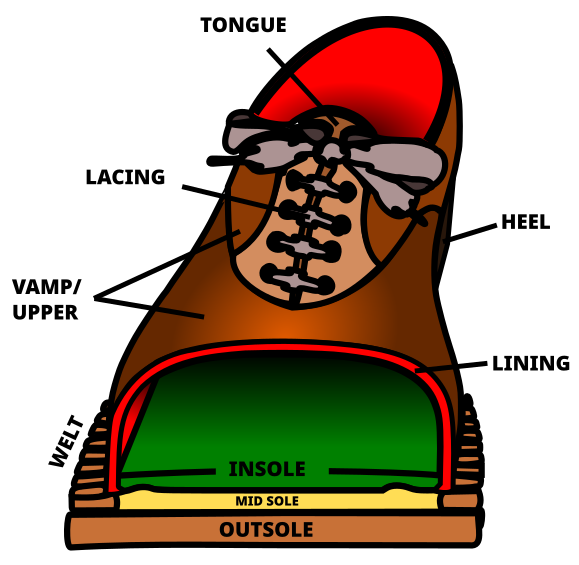
The basic anatomy of a shoe is recognizable, regardless of the specific style of footwear.
All shoes have a "sole", which is the bottom of a shoe, in contact with the ground. Soles can be made from a variety of materials, although most modern shoes have soles made fromnatural rubberpolyurethane, or polyvinyl chloride (PVC) compounds.[31] Soles can be simple — a single material in a single layer — or they can be complex, with multiple structures or layers and materials. When various layers are used, soles may consist of an "insole", "midsole", and an "outsole".[32]
The insole is the interior bottom of a shoe, which sits directly beneath the foot under the footbed (also known as sock liner). The purpose of insole is to attach to the lasting margin of the upper, which is wrapped around the last during the closing of the shoe during the lasting operation. Insoles are usually made of cellulosic paper board or synthetic non woven insole board. Many shoes have removable and replaceable footbeds. Extra cushioning is often added for comfort (to control the shape, moisture, or smell of the shoe) or health reasons (to help deal with defects in the natural shape of the foot or positioning of the foot during standing or walking).[32]
The outsole is the layer in direct contact with the ground. Dress shoes often have leather or resin rubber outsoles; casual or work-oriented shoes have outsoles made of natural rubber or a synthetic material like polyurethane. The outsole may comprise a single piece, or may be an assembly of separate pieces, often of different materials. On some shoes, the heel of the sole has a rubber plate for durability and traction, while the front is leather for style. Specialized shoes will often have modifications on this design: athletic or so called cleated shoes like soccer, rugby, baseball and golf shoes have spikes embedded in the outsole to improve traction.[32]
The midsole is the layer in between the outsole and the insole, typically there for shock absorption. Some types of shoes, like running shoes, have additional material for shock absorption, usually beneath the heel of the foot, where one puts the most pressure down. Some shoes may not have a midsole at all.[32]
The "heel" is the bottom rear part of a shoe. Its function is to support the heel of the foot. They are often made of the same material as the sole of the shoe. This part can be high for fashion or to make the person look taller, or flat for a more practical and comfortable use.[32]
The "upper" helps hold the shoe onto the foot. In the simplest cases, such as sandals or flip-flops, this may be nothing more than a few straps for holding the sole in place. Closed footwear, such as boots, trainers and most men's shoes, will have a more complex upper. This part is often decorated or is made in a certain style to look attractive. The upper is connected to the sole by a strip of leather, rubber, or plastic that is stitched between it and the sole, known as a welt.[32]
Most uppers have a mechanism, such as laces, straps with buckles, zippers, elastic, velcro straps, buttons, or snaps, for tightening the upper on the foot. Uppers with laces usually have a "tongue" that helps seal the laced opening and protect the foot from abrasion by the laces. Uppers with laces also have eyelets or hooks to make it easier to tighten and loosen the laces and to prevent the lace from tearing through the upper material. An "aglet" is the protective wrapping on the end of the lace.
The medial is the part of the shoe closest to a person's center of symmetry, and the lateral is on the opposite side, away from their center of symmetry. This can be in reference to either the outsole or the vamp. Most shoes have shoelaces on the upper, connecting the medial and lateral parts after one puts their shoes on and aiding in keeping their shoes on their feet. In 1968, Puma SE introduced the first pair of sneakers with Velcro straps in lieu of shoelaces, and these became popular by the 1980s, especially among children and the elderly.[33][34]
 

Ads

Blogroll

Search in the Quran
Search in the Quran:
in
Download Islamic Softwares FREE | Free Code
www.SearchTruth.com

About